Showing posts with label ALUMINIUM. Show all posts

Friday, June 13, 2014

IDEA - Kelly Kettle, plus some musings on efficiencies & enviROIs

One of the joys (of many) of this lark is what you can stumble across. 

And, of course, who. Which can always lead on to all sorts more fun stuff.

The other day on twitter I shared a link to an electric 'eco-kettle' (I'll save detail on this for another day, as this thread is set to head off on enough tangents already).

Suffice to say it was... is... claimed as a very green way to boil water.

I was convinced enough to be tempted, and shared this intention on said twitter, FaceBook, etc. I believe I added a caveat on its claimed values until bought and tried.

What followed was a most interesting serious of exchanges on what it takes to boil water, as you do, with an impressively credentialed gentleman who goes under the name of Roger Tallbloke. On many matters, but especially science and even more so that of climate, well worth a follow:

https://twitter.com/RogTallbloke
http://tallbloke.wordpress.com/

With that too often over-used and abused (esp. by our glorious 4th estate) term, I think he'll allow me to also confer upon him the accolade of on occasion erring on the 'controversial', but then who worth their salt is not?

But he and I do share a love of science, engineering and, crucially, second-use design (which we will get to soon, promise).

However reductions of waste and promotions of efficiencies do also score high with us.

So let me simply share what he did with me to my apparently incorrect notion that an electric kettle was the most eco (we shall suspend such as health & safety, speed, style & convenience factors for now) way to get water hot:

RT: Electric is a lot less energy efficient than gas for domestic water boiling.
JM: Really? Presumed an element within water was much more efficient than what first needs to heat pan & gets lost around edges.

RT: A lot of energy wasted heating air in bubbles forming on element which then rise to surface and lost to atmosphere. Well designed gas kettle loses little heat because turbulence makes heat cling to sides and be absorbed through to the water

RT: Other forgotten factor in elec vs gas is transmission losses for elec. Mad use of high grade energy for instant gratification.

He then topped the lesson with a lovely design example, including data:

RT: My 2oz kelly ketttle design boils a pint in 4 mins with 16g denatured alcohol. around 56% efficiency.


(Tangent - Interestingly enough, I just took delivery of a 'Junkk' Stirling Engine kit (sadly half the parts missing) that looks just like this. It will be subject of another post once finished, so watch this space. Clearly aluminium beer cans also have their re-uses.)

He has offered to expand when he has a moment, which may happen here, or on the 'Idea Page' on the site I have created in complement.

http://www.junkk.com/junkkdetail.asp?slevel=0z622&parent_id=622&renleewtsapf=2011

-----
Roger has kindly amplified in significant detail:

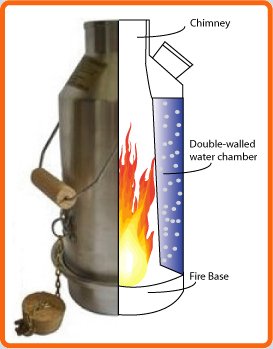
For those who don't know what a kelly kettle is, look at this cross section:
http://www.woodlands.co.uk/blog/wp-content/uploads/kelly-kettle.jpg

Usually made from 16 gauge aluminium (old ones in copper), they are too heavy for solo backpackers but great for windy campsites.

So I made this lightweight version using UK and USA beer cans (they do the big in america). Rather than using wood for fuel I keep it clean using ethylated spirit (denatured alcohol). The stove at the bottom has two sets of flame-jet holes which heat both the inside and outside of the kettle. A simple aluminium windshield made from an extra large beer can opened out is used as necessary.

The kettle sits on the stove and uses a large american Fosters can with an internal chimney made from a UK beer can of smaller diameter. They are jointed with aluminium solder (and a lot of patience and swearing).

The chimney has flutes folded into it so it tapers from a wide circular base to a narrow 5 pointed star at the top. This raises the velocity of the combusted gases, creating the 'draw' to make the boil happen quickly. The 'hat' in the photo is a section of UK beer can with exhaust holes in and it conducts exhaust gas heat back into the water.


Updates posted - 16/05/14:

If you take care with drying times, you can use superglue for jointing and it'll last 20-30 boils.

I also make smaller versions with pint UK beer can + 2x red bull cans for chimney. Tricky jointing. Just enough for a cuppa. 1oz


The UK version uses a 4g stove made from a lip balm tin - 'internal' jets only. In use here on Red Pike

-----


Finally comes the tricky bit as I need to refer to the blog there and the site page here, but to cut and copy across I need to publish both, go back and then re-edit. Or something.

Enjoy!

Tuesday, June 18, 2013

Collective Weight

Every so often a notion occurs.

And I think I am getting to an age where it's best to pop it down somewhere as my mind these days is so filled with competing thoughts, and evidently less able to recall them, a written record seems a wise precaution.

I was clearing out some junk, as the proportion that has remained junk as opposed to getting converted into useful 'Junkk' is still, sadly, skewed towards the divorce courts.

Amongst a lot that really has to go, and doesn't look like inspiring much now if it hasn't already, is a fair old selection of cardboard, especially in the form of Pizza and Cereal boxes. Still great for filing, but... there's really only so much filing one needs now, especially as that little box just over there is storing 500GB paperlessly, with an even smaller one next to it in reassuring back-up, with the cloud as belt and braces.

The loo rolls are staying, as I have a pretty nifty scheme for these, involving an old drill stand I located (see if you can guess what may be going down there before I unveil this idea).

I think the Tetrapaks have to go, too. I may keep the spout/caps, but they are a lot of bulk with little second use so far inspired.

Which brings me to the cans. Steel ones not so many as we seem to be getting fresher and fresher in our diet, and while I can see some value in the lipped variety connecting together to form tubing, they are darn near uncrushable and hog space.

Which brings me to the aluminiums. For sure we have a lovely haul of ring pulls to conjure with, but the cans themselves? 

I had been simply crushing them to save space, but even this has mounted up.

Cue... the notion.

On our own, over time, we have created a fair old collection, and in crushed form the sacks are barely liftable. But if I simply pop them in the recycling, I am sure the bin men will grumble but their bosses will be thrilled. Pre-processed raw metal!

A while ago I did ask around at what point it all got financially viable to 'the industry' and, hence, in turn, the individual.

A few questions arose and still need clarifying...

1) What quantity makes a delivery (by me) viable?

2) What more makes a collection (by them) viable?

Simple stuff, as I am thinking of creating a Junkk.com master page with a chart. Something like:

RECYCLATE - Delivery/ton - Collection/ton - Value/ton - Local connection
Steel______l____________l____________l_________l_____________
Alumimium_l____________l____________l_________l_____________
Glass______l____________l____________l_________l_____________
Plastic_____l____________l____________l_________l_____________
Textiles____l____________l____________l_________l_____________

(see how Blogger formatting messes with that between post creation and print)

This can then be simply cut and pasted as data comes in on a postcode by postcode area basis.

I see potential because, presuming any community can find its own storage area, while one person may struggle in a sensible timeframe to build up enough to make it worthwhile, many pooling resources might yet see enough to profit in the effort.

Monday, June 22, 2009

PROF'S POSER - Heat and rust

Ok, best I could do.

And wrong from the off, as aluminium doesn't rust.

However it does frame this Prof's Poser, which is essentially an enviROI-based one pondering energy consumption.

Over the weekend I was making an oven-heated meal. And it dawned on me that I was popping a sheet of foil in the glass dish.

Now the picture shows it all becomes moot pretty quickly anyway as the foil ripped, but I was wondering which was more energy efficient, and hence 'better': cook in foil and incur the costs of that resource being used and disposed of (there's a limit to how food caked it can be to [put out to] recycle), OR just use the glass and end up with a few pints of boiling water being required.

Tuesday, April 08, 2008

NEWS/Commercial PR - Educational Tool for School

PR as supplied, with edits for space.

NEW RESOURCES TO HELP TEACHERS ‘THINK CANS IN THE CLASSROOM’

Novelis Recycling has launched free site ‘Think Cans in the Classroom’ as part of its ongoing programme to link aluminium recycling to core curriculum subjects. The web-based resources provide a range of interactive activities for teachers in primary and secondary schools, plus supplementary information for parents and pupils.

Novelis Recycling has developed the resources in close consultation with teachers and education professionals; including experts from Catalyst Science Discovery Museum
and Thinktank, Birmingham Science Museum. In addition to updating the site’s existing resources for primary schools, new features have been added, including lesson plans for Key Stage 4 (14-16 years) Enterprise and GCSE science.

Think Cans in the Classroom also includes updated resources for primary schools, with activities that can be used across the curriculum in subjects ranging from Science to Design Technology. There is also information for parents to help them reinforce children’s learning at home.